
Creativity Comeback: Pedaling Toward Lift-Off
Written by Nathan A. Knick
Illustrated by Ruby “RJ” Jensen
Growing up in the 80s and 90s had its perks—chief among them, the freedom to play
with almost no restrictions. I lost count of how many forts my brother and I built, using
couch cushions, wood scraps, sticks, blankets—anything we could get our hands on.
We created our own adventures: designing new paper airplanes, inventing hallway
games, or discovering that Pledge on linoleum made for a surprisingly slick (and
hilarious) ride.
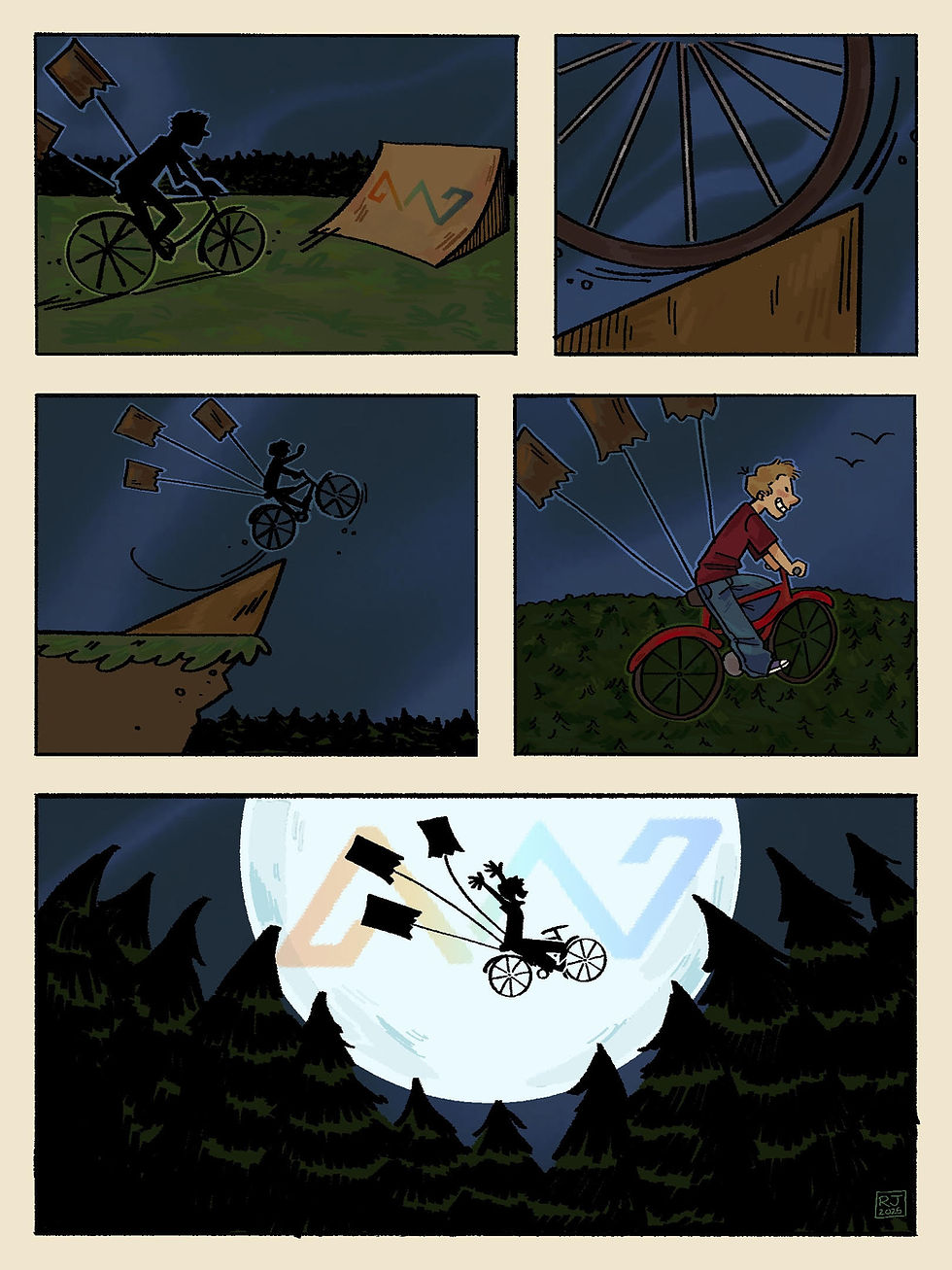
At six years old, I remember planning with my brother how to build a flying bike. Paper
bags, string, and a little ingenuity were all we needed—or so we thought. It never left
the ground, but the real magic was in the process: brainstorming, experimenting, and
testing our ideas without even realizing we were learning about forces like “lift” and
“gravity.”
So what’s changed since then? Why, in the 2000s and beyond, do we need to
intentionally cultivate creativity when it once seemed so natural? The Partnership for
21st Century Learning, now part of Battelle for Kids, identifies Creativity as one of
the “4 Cs” essential for student success—alongside Critical Thinking, Communication,
and Collaboration (Partnership for 21st Century Learning, n.d.). While I’m grateful it’s
recognized at this level, I can’t help but wonder: Why does creativity even need to be
listed as a skill we need to intentionally develop? Shouldn’t it be a natural part of
childhood?
That question led me to a landmark NASA-commissioned study conducted by George
Land and Beth Jarman in the 1960s, later detailed in Breakpoint and Beyond (Land &
Jarman, 1992). The study tested 1,600 children for divergent thinking—the ability to
generate creative ideas. At age five, 98% of participants scored at the “genius” level in
creativity. By adulthood, only 2% reached that same level. Land concluded that this
decline wasn’t a natural process, but rather the result of uncreative behaviors being
taught and reinforced over time—often in school.
I’ve thought a lot about this. Was it school alone? I had teachers who could put me to
sleep, and others who made their subject matter come alive. Then came the internet,
smartphones, CNC machines, 3D printers—and now, artificial intelligence. With all of
these tools, is creativity still necessary? Absolutely. In fact, it’s more essential now than
ever.
I’m done just asking questions about the so-called “creativity crisis.” It’s time to be part
of the solution. That’s where Art Wars comes in. Our mission is to Advance the Artist,
Build the Builder, Create the Creator, and Inspire the Innovator. Through high-energy,
“in-the-moment” art competitions, we give young artists the chance to develop their
creative skills under pressure—while having fun. It’s action-packed, intense, and deeply
rewarding for students who thrive in artistic expression.
Alongside the competitions, Art Wars Education will develop into a full support system
for young artists—offering career insights, self-development and business tutorials,
artist interviews, college connections, and scholarship opportunities. We’ve already
impacted hundreds of students in South Dakota and Minnesota, and we’re on a mission
to go national, giving more students the chance to strengthen their creativity through the
arts.
I’m genuinely excited for the future of the arts—and for the role creativity will play in
shaping our world. Creativity has always been inside us. It built civilizations, imagined
the internet, and even conceived of AI. It’s not a luxury—it’s the engine of progress. The
question isn’t whether you have it, but whether you’ll choose to develop it.
My brother and I never got that bike to fly—but not for lack of spirit. With the right
resources, I believe we could have done it. Today, Art Wars is that flying bike. The
framework is built, momentum is building, and lift is happening. Soon, we’ll be soaring.
If you’d like to fuel this flight, visit www.theartwars.com and click “Donate.” Together,
we can help creativity take off.
Related Links
References
Partnership for 21st Century Learning. (n.d.). Framework for 21st Century Learning. Battelle for Kids. Retrieved from https://www.battelleforkids.org/networks/p21
Land, G., & Jarman, B. (1992). Breakpoint and Beyond: Mastering the Future Today. HarperBusiness.
Comments